
Architecture / Migration / OperationsThe right cloud.
The right cloud.
For the way you work.
Assess the workload, design the operating model and plan the move. Build a cloud environment your team can run, secure and recover.
 Built around your environment.
The business contextA practical answer
A practical answer
to everyday complexity.
A cloud decision is a workload decision. Applications have dependencies, users have access requirements and the business has expectations about availability, operating costs and recovery. Moving a virtual machine is only one part of the change.
AXO helps shape the target architecture and migration approach around those requirements. Public, private and hybrid options are evaluated alongside identity, connectivity, data protection and the team that will operate the environment afterwards.
Is this your starting point?
When this service fits.
Common reasons to start the discussion.
Cloud spending increases without clear resource ownership.
Backup exists, but a complete recovery approach has not been tested.
What the scope can cover
The work behind the outcome.
A detailed starting point, shaped into a proposal for your environment.
Public, private & hybrid design
Compare deployment options against workload needs, connectivity, ownership and cost. Define how public cloud and private infrastructure should interact, and which dependencies must remain available.
Workload assessment
Review application components, data, performance needs, integrations and identity. Create a workload inventory and identify prerequisites that may affect the target design or migration sequence.
Migration planning & cutover
Group workloads into migration waves, define validation criteria and assign cutover decisions. Include data movement, change communication, rollback arrangements and acceptance by the business owner.
Cloud operations & optimisation
Agree monitoring, maintenance, access and cost-review responsibilities. Investigate idle or oversized resources against actual workload behaviour before changing capacity.
Backup & disaster recovery
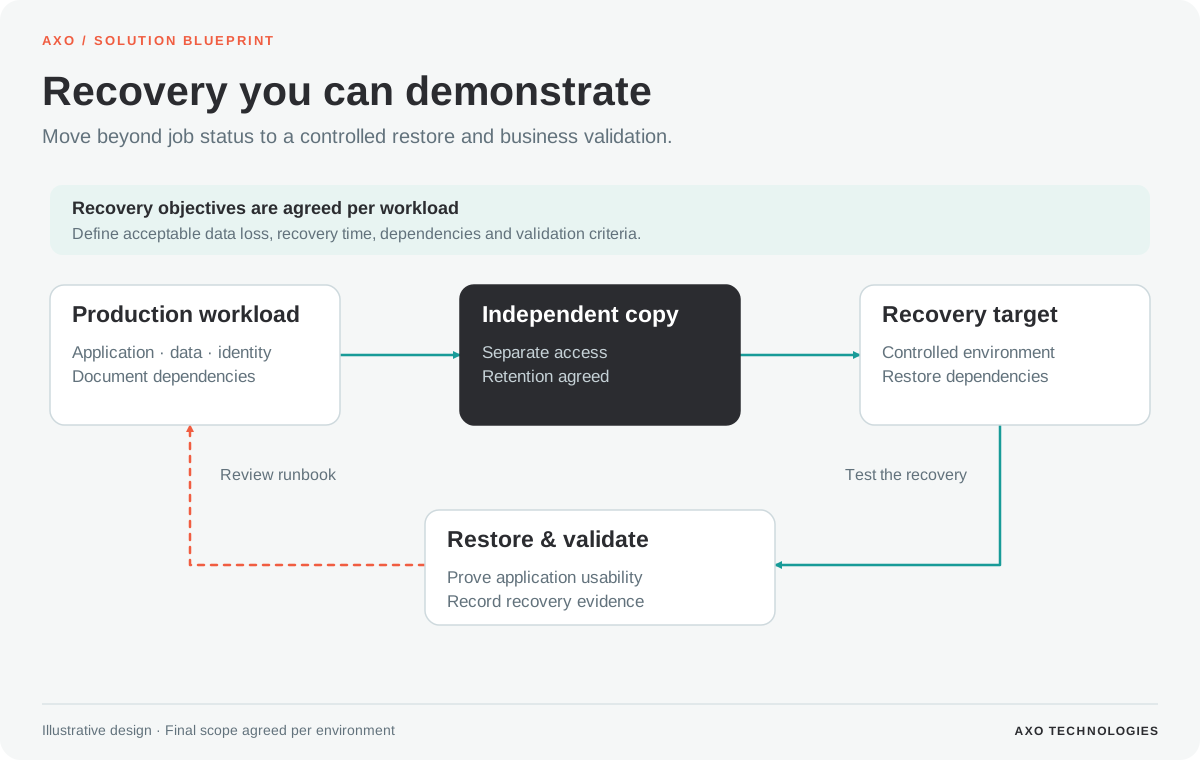
Define recovery priorities and acceptable data loss per workload. Plan retention, backup separation, restore testing, recovery dependencies and the point at which the business validates the recovered service.
Identity & cloud security
Review privileged access, authentication, network exposure and baseline configuration. Record the ownership of identity, secrets, changes and monitoring across each environment.
Solution, made visible
See how the pieces connect.
Explore the operating model and the decisions around it.
Placement
Place applications in public cloud, private infrastructure or a combination after reviewing their dependencies and operating constraints.
Access & connectivity
Identity, privileged access and network paths are shared foundations. Define trust boundaries before opening connections.
Operations & recovery
Performance, spending, security and recoverability need owners after migration, with an agreed review and test cycle.
A recoverable businessPlan the recovery.
Plan the recovery.
Then test the service.
Recovery depends on systems, people and a sequence the business can validate.
| Model | Useful when | Decisions to resolve |
|---|---|---|
| Public cloud | Platform services or flexible capacity fit the workload. | Identity, connectivity, operating cost and platform dependencies. |
| Private infrastructure | A dedicated environment fits the workload or operating constraints. | Capacity, lifecycle, site dependencies and recovery. |
| Hybrid cloud | Different workloads need different environments. | Trust boundaries, network paths and ownership across both sides. |
Tangible deliverables
Know what you should receive.
Documents, records and decisions that help your team operate afterwards.
Workload & dependency assessment
An inventory of applications, data, integrations and operating constraints.
Target architecture
Deployment options, connectivity, identity and security boundaries.
Migration runbook
Waves, tests, cutover ownership, rollback and acceptance criteria.
Operations & recovery plan
Maintenance, cost review, monitoring, backup and recovery responsibilities.
The delivery journeyFrom first conversation
From first conversation
to accountable ownership.
Assess
Understand workloads, dependencies and business priorities.
Design
Compare options and agree the target architecture and operating model.
Migrate
Test, move and validate workloads through controlled migration waves.
Operate
Review performance, cost, security and recovery readiness.
Experience in practice
A related AXO engagement.

Cloud & Infrastructure
Infrastructure modernisation for a technology company
The Malaysian branch wanted to modernise legacy infrastructure while considering operating costs and the investment model.
Explore the project ↗A useful starting point
Look inside the deliverables.
Sample templates illustrate a reporting or handover structure. They contain no client data.
IT onboarding checklist
A practical template for inventory, access, responsibilities, dependencies and service acceptance.
Download PDFCompany profile
A concise introduction to AXO, our core services and delivery approach.
Download PDFBefore we beginYour questions.
Your questions.
Clear answers.
Should every workload move to public cloud?
No single deployment model suits every workload. Compare application needs, connectivity, costs, data requirements and operational ownership before choosing.
Can you support a hybrid environment?
A hybrid design can connect private infrastructure and public cloud. The scope should include identity, connectivity, monitoring and recovery across both sides.
How is migration downtime planned?
The cutover plan identifies data synchronisation, dependencies, test results, business approval and rollback decisions. A downtime commitment requires assessment of the actual application.
Is backup the same as disaster recovery?
Backup protects recoverable copies of data. Disaster recovery also addresses the systems, identity, connectivity, people and sequence needed to restore a working service.
Can we control cost without hurting performance?
Start with resource ownership and workload evidence. Validate optimisation changes against performance and recovery requirements, then review the billing effect.
Start with a conversation
Discuss your requirements ↗Let’s shape the right cloud approach.
Tell us about your environment, your priorities and the outcome you need.