
Picture a semiconductor assembly line in Batu Kawan. A high-speed camera is watching microchips roll past at a few hundred units a minute, looking for defects. It spots one. It now has roughly five milliseconds to tell the robotic arm downstream to flick that chip off the belt before it gets packaged and shipped.
If that decision relies on a server in Cyberjaya or Singapore, the delay causes the defective chip to pass the robotic arm completely. It gets packaged and shipped out, leaving us to bear the return costs and face customer complaints later.
This is the small, unglamorous problem that edge computing is built to solve. Instead of sending every byte of data to a central cloud, you put some processing power right where the data is born — on the factory floor, in the retail outlet, at the port crane.
The decision happens locally, in microseconds. Only the result travels upstream.
As Malaysian businesses deploy more automation, IoT sensors and AI, and as 5G matures here, the question of where your data gets processed becomes a strategic one. This piece looks at where edge genuinely earns its keep, and how to deploy it well.
Edge computing is a distributed architecture that processes data close to where it is created, using local compute, storage and networking, instead of shipping everything to a centralised data centre.
The edge is not one thing. It is a connected range of technologies, from constrained sensor nodes and on-premise edge servers, through to Multi-access Edge Computing (MEC). This MEC is cloud-grade compute hosted inside a telecom network, which is much closer to the user than a faraway hyperscaler region.
The cloud is not going anywhere. Edge complements it, handling the workloads the cloud is structurally weaker at — sub-ten-millisecond control loops, raw video from many sites, sensitive personal data you would rather not transmit.
Three things have changed in the last few years that make edge a live conversation for Malaysian businesses rather than a hypothetical one.
First, the policy and infrastructure scaffolding is in place. The Malaysia Digital Economy Blueprint (MyDIGITAL) and the National Fourth Industrial Revolution Policy set the national frame for digital transformation, and JENDELA Phase 2 (2023 to 2025) targets nine million premises passed with gigabit fibre and 100 Mbps mobile broadband leveraging 5G.
Second, 5G has matured through a real structural shift, from DNB's single wholesale network to a dual-network model in which U Mobile is licensed to build the second nationwide 5G network — and 5G is the radio layer that makes many edge use cases viable.
Third, you can now buy edge as a service through multiple channels. Maxis, with HPE, launched Malaysia's first commercial MEC offering single-digit-millisecond response times, while TM Global markets dedicated edge-compute solutions.
Alongside these big names, Managed Service Provider (MSP) and System Integrators (SI) also offer managed edge deployments to handle hardware setup and software integration. Globally, the edge market is projected to grow from about USD 658 billion in 2026 to nearly USD 1.9 trillion by 2031, with Asia-Pacific the fastest-growing region.
Not every workload belongs at the edge. The five situations below are the ones where the math, the physics or the regulation genuinely pushes you away from a pure cloud setup.
This transition is already unfolding across Penang’s industrial ecosystem. The region is heavily dense with high-speed automated optical inspection (AOI) systems, built to serve a critical semiconductor and electronics sector. At the same time, Malaysia's broader smart-manufacturing market is surging ahead, propelled by the aggressive adoption of IoT, AI, and robotics.
In this high-stakes environment, cloud computing encounters a hard physical limit. When a defect-detection model has to wait for a round-trip to a distant cloud region, it isn't inspecting in real time. It is inspecting in hindsight.
By the time the verdict finally returns, the defective part has already moved down the line.Edge computing solves this by pushing the inference directly onto the factory floor. The process is instantaneous: the camera feeds a local edge server, the model executes on-site, and the robotic arm receives its instruction in microseconds.
With commercial MEC offerings in Malaysia now advertising single-digit-millisecond response times [9], the technology has reached the exact order of magnitude required for closed-loop industrial control.
The cloud still retains a vital role—acting as the central brain where models are trained on weeks of historical data and defect rates are aggregated across production lines. However, when it comes to the split-second actions of the factory floor, the decision belongs at the edge.
Data is heavy, and moving it costs money. Consider a quick-service restaurant chain with a hundred outlets, each running an AI camera over the drive-thru to count cars and predict kitchen load.
A single high-definition camera streaming 24/7 generates gigabytes of data every single hour. Multiply that by a hundred outlets, and you are dealing with a staggering volume of information—the vast majority of which is just footage of empty lanes.
Sending all that raw video to the cloud causes your bandwidth bill to balloon.
Deploying a small edge device in each outlet completely changes the picture. The device processes the model locally, counts the cars, and sends nothing more than a tiny text update upstream: "Outlet 42: 5 cars, prep more fries." The heavy, raw video is analyzed and discarded right on-site.The math makes the benefits clear. A text update takes up only a few hundred bytes, compared to roughly ten megabytes of HD video per minute.
By shifting to the edge, data transmission drops by several orders of magnitude. For high-volume media use cases, these massive bandwidth savings can easily pay for the edge hardware within months.
Malaysia’s data protection landscape shifted dramatically with the passing of the Personal Data Protection (Amendment) Act 2024. Under the new Section 12B, organizations now face mandatory breach notifications, with non-compliance carrying heavy penalties of up to RM250,000, two years of imprisonment, or both. Furthermore, the amendments strictly reclassify biometric data as sensitive personal data and introduce much tighter rules on cross-border data transfers.
In this strict regulatory environment, sending raw, identifiable data to the cloud becomes a massive legal and financial liability.
Edge computing solves this by completely flipping the data model.
Take an in-store video analytics workload, for example. Instead of streaming surveillance footage to an external server, the video never leaves the local device. The edge device processes the footage on-site, extracts the necessary metrics—such as foot traffic counts—and immediately overwrites the raw video.As a result, only a completely anonymized data point ever leaves the building.
In a single move, you drastically shrink both your cyber attack surface and your compliance risk. The only catch is ensuring that the edge devices themselves are physically secured and strictly configured to discard the raw data immediately.
If your safety systems, machine interlocks, or access control all depend entirely on a cloud round-trip, you are carrying a massive risk. A single severed fiber optic cable does not just pause your business—it can instantly shut down operations or create a severe safety hazard on the ground.
While initiatives like JENDELA are making real progress in expanding rural and underserved connectivity, the reality remains: no infrastructure plan can make a single network link completely infallible.
Edge computing solves this vulnerability by delivering true operational resilience. By moving critical control loops onto local hardware, your most vital systems keep running smoothly even if the upstream network link drops entirely. The edge device simply queues up non-critical background data locally, waiting to sync it back to the cloud the moment the connection returns.
For industrial sites operating outside the Klang Valley—or anything deployed in remote areas of Sabah and Sarawak, or sitting completely offshore—this architecture is vital. It is the definitive difference between a graceful degradation of services and a sudden, catastrophic hard stop.
AI is only useful if it can get data fast enough to actually act on it. Consider the automated guided vehicles (AGVs) and driverless forklifts now moving massive containers at Malaysian ports. Port Klang has been actively studied as a prime smart-port case, and an entirely new AI-powered port near Kuala Lumpur is currently in development.
In these environments, timing is everything. An AGV must know, in absolute real time, exactly where it is, where other vehicles are moving, and whether a worker has just stepped directly into its path.
If that vehicle has to wait to ask a remote cloud server whether or not to slam on the brakes, it has already hit something.
The entire perception, prediction, and safety logic must run directly on the vehicle itself or on a local edge node. For any business that is serious about deploying robotics or autonomous systems, edge computing is not an optional add-on. It is the fundamental foundation that makes the entire system work safely.
Edge is not a plug-and-play upgrade. Treating it as one is the fastest way to spend money without seeing a return. Every edge device requires capital expenditure along with power, physical housing, monitoring, and patching. Furthermore, a fleet of distributed devices creates management complexity, commonly known as edge sprawl. Organizations should plan for this complexity upfront rather than discovering it later.
Edge and IoT devices also carry unique security risks because they have limited computing resources for hardened defences. As a result, the device fleet itself becomes a new set of endpoints to protect. Ultimately, the honest comparison is not "edge versus cloud." Instead, organizations must weigh "edge plus its management" against "cloud plus its bandwidth and latency cost." The right split depends entirely on the specific workload.
Most Malaysian businesses benefit from starting with a focused pilot. First, identify one workload where the math clearly works. Examples include a latency-sensitive production line, a bandwidth-heavy camera fleet, or a regulated data stream. Next, prove the return against a clear baseline before expanding.
For organisations without in-house distributed-systems capability, a MEC model hosted by a telco or MSP is often the lower-risk entry point. Under this model, the service provider handles hardware, patching, and physical security. You can then simply consume the compute as a service. The edge-versus-cloud picture, at a glance:
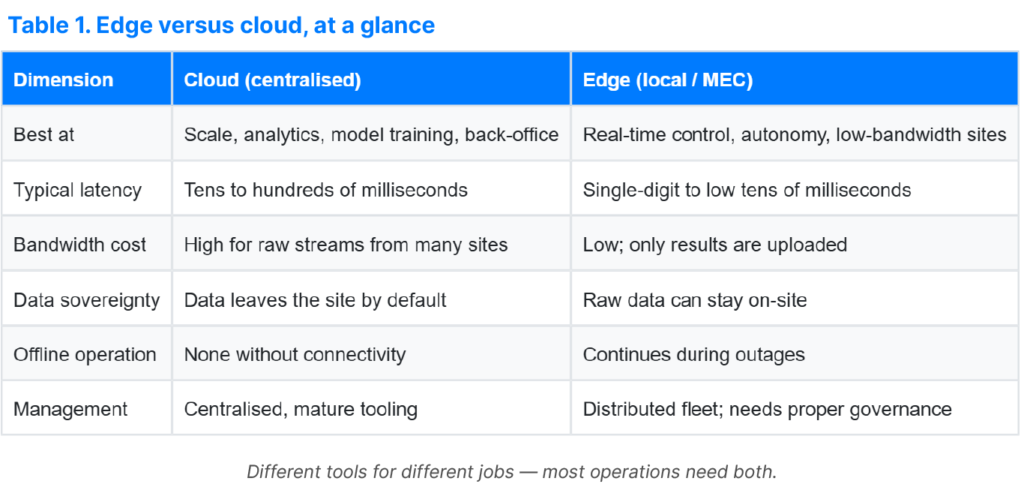
Here is the bottom line. Edge computing is a scalpel, not a hammer. Use it only where the problem demands it. That means where latency, bandwidth, compliance, or resilience makes the cloud genuinely unworkable. Everywhere else, the cloud is still cheaper, simpler, and safer.
The Malaysian infrastructure is now mature enough that you can deploy edge if you need to. 5G is rolling out. MEC is available as a service from Maxis and TM. If your needs are more specific, you can also engage local MSP or SI to design and manage a tailored edge solution for you
The 2024 PDPA amendments also give you an extra reason to keep certain data local. But just because you can, does not mean you should.
So before you buy anything, audit your workloads honestly. Most of your IT systems belong in the cloud. HR, finance, email, CRM, ERP. They are cheaper and easier to manage there. Edge belongs only in the operational corners of your business. The production line. The port. The retail floor. The remote site. The autonomous machine.
Find one of those corners. Pilot it. Measure the return against a clear baseline. Then decide whether to expand.
AXO Technologies has helped Malaysian businesses and government organisations design IT infrastructure that saves money, reduces risk, and keeps them competitive. Let us do the same for you.
Ready to find out where edge computing can actually work for you? Contact us now.